
StoryBank
Stories rarely arrive fully formed. They begin as moments worth noticing.
StoryBank is where we collect them — conversations, observations, client words, experiences, references, photographs and ideas we don't want to lose.
Some will become stories. Some will connect to something else. Some may simply stay here.
This is what paying attention looks like in practice.

Trying to figure out lower back pain and posted to Facebook asking for recommendations. One person gave me the name of a local chiropractor.That was the referral — then I went to his website. It was personable, with professional photos and the story behind the practice. When I called, instead of hold music, a kind voice told me more about the practice, its history and mission and ended with, “You’re in the right place. We’re happy you’re here.” If you were on hold longer, the narration continued: “Our business comes from referrals.”I have an appointment booked for next week.A recommendation from a stranger. A website. A hold message. All building trust.

Shooting a good friend.
Click image to view the full gallery! 📷
I responded to an RFP four years ago — spent hours and hours drafting the proposal and meeting with the team. Despite being the marketing director’s “favorite vendor,” the CEO ultimately chose someone else for the project. Fast forward to today: that same marketing director is at a new company and remembered my name. She reached out to book a series of employee headshots. I knew the company was planning a new website, so I shared Connection Catalyst with her. We’re now working together on what has become the biggest project — and one of the most rewarding — of my career.Simply because I made time to follow through, find the opportunities, and stay connected.
“But the irony is the people most game to travel—junior workers—are the ones who tend to get left out when companies tighten their travel budgets.”
“It’s about being in the room where it happens, where deals are getting done.”
“…more likely to discover unexpected opportunities when he travels to meet with clients than he would during a single-topic Zoom call. … The customer filled him in on a line of business that Tedesco previously wasn’t aware of, and the two agreed to follow up about the prospect of additional work together.”
Lorem ipsum dolor sit amet, consectetur adipiscing elit, sed do eiusmod tempor incididunt ut labore et dolore magna aliqua.
At Chick-fil-A trying to work while the kids played. One of them dumped my entire 32 oz. Diet Dr. Pepper across the table. Saved the laptop, grabbed a million napkins, stayed mostly calm.
As we were leaving, another mom stopped me and said,
“I saw how you handled that with your kids and you stayed so calm. You’re doing a great job.”
I cried. She had no idea I’d spent the morning questioning a big decision we’re making for one of my kids and wondering whether I was doing the right thing as her mom.
A stranger noticing something completely ordinary and saying it out loud. Exactly the words I needed that day.
"Ours is a restless age, and rootlessness is one of its costs. Families move more often than they once did, while commerce and conversation increasingly take place through screens. We have grown accustomed to treating one town as interchangeable with the next, and one community as easily left behind for another....
Affection has a geography. It takes root in the soil closest to home and, only with time, extends outward to embrace a wider world."
The best photos from a shoot often happen immediately after I say, “It’s a wrap.” The next five or ten frames can be some of the most genuine of the entire shoot — people finally stop performing and relax. They’re suddenly more present.
"Between 2003 and 2024, the amount of time that Americans spent attending or hosting a social event declined by 50 percent."
“Volunteers awarded every attendee a bingo card with entries like, ‘I introduced myself to 3 new people’ … But the warehouse also was booby-trapped with Instagrammable photo-ops. Those quickly became the main attraction.”
“If Americans are going to claw back genuine community from the digital age, they’re going to need more practice.”
I remember a middle school math teacher telling me she could always tell how well she was teaching by the look on my face.If I was tracking, she knew it. If I wasn’t, she knew she had to try a different way. I’ve always been a deep thinker and a deep question asker.
I’m not worried about AI taking my job. I’m focused on developing connection while the world seems dead set on destroying it. When the kids in this photo grow up, and all they know is how to emotionally regulate in front of a screen, someone is going to need to (re)teach them how to live with humans. How to connect. WorkLife Studios plans to be part of that solution.
I recently met with a LinkedIn copywriter whose previous title, at a well-known agency in town, was Head of Growth. I assumed that meant growth as in growing the team, growing capacity, growing in knowledge or capability. I learned that Head of Growth means growth in sales. Apparently, it's a big Silicon Valley thing. (I looked it up. It is.) Since when did we limit growth to sales? Yes, growth can mean sales. But it should mean so much more.
Just completed a huge milestone: graduation from the Goldman Sachs 10,000 Small Businesses program. My business growth plan from 10KSB includes revenue projections, hiring plans, margins and market research.It also purposefully includes a white farmhouse and a flock of sheep. Biggest takeaway from the program: My business plan is also a life plan.
I was part of the high school swim team — never won a race but loved every minute of it. My mom told me once: “You’re not the fastest, but you sure are graceful when you swim.” I feel that tension in my business — the pressure to be fast. To grow quickly. But like swimming, I’ve been slow and intentional with each evolution of my ideas, work and relationships. Maybe graceful, too. I’ve also had fun every minute of it.
.avif)
For several years, much of my business was built during short windows of childcare — 2.5 hours at the local gym. I felt incapable of investing in more regular childcare to the tune of $1,600 a month for two kids, three days a week.It took a overwhelm -- and a therapist -- therapist and to help me realize I didn’t have to commit to it forever. I could try it for three months and see what happened. Would my revenue change?This month , I made the jump and added more part-time childcare. Within two weeks, I landed the largest retainer of my career: $1,850 a month.Take away taxes and expenses, and my childcare was covered. To the dollar.I get chills when I think about it.
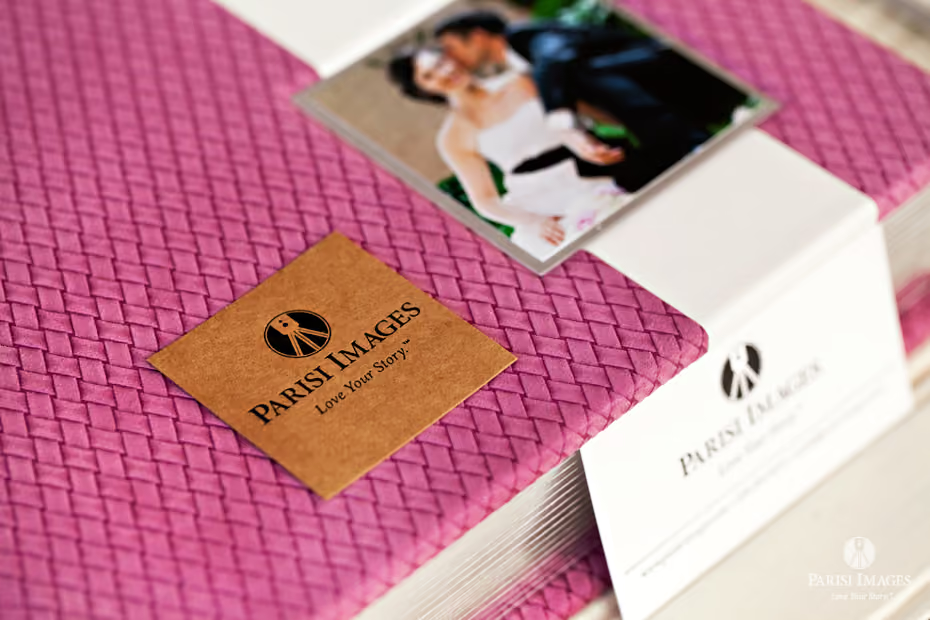
When I photographed weddings, I used Love Your Story as my tagline.
I was most drawn to weddings that felt like the couple — sometimes smaller or lower-budget, but deeply personal. I wanted my work to show them that the way God had written their love story was their own, and that it was worth celebrating.
I still believe this — and somehow managed to carry that same heart into the business world. So many founders dismiss the things that make their businesses different as arbitrary or insignificant. But when we start peeling back the layers, those nuances are often the exact pieces of the story worth telling.
Maybe Love Your Story has been the throughline all along.
When photographing a company picnic an employee shared that she hadn’t planned to stay with the company and had seriously considered leaving.
Me: “What made you stay?”
Employee: “They found a new role for me that I was able to thrive in.”
Two sentences that said so much about the company. I never would have heard them without the access the camera gave me — showing up, paying attention, and asking one more question.
I believe celebration is one of the biggest ways we connect with others. That's why we'll take out a second mortgage just to pay for our wedding. Or why HGTV couples always want to get a bigger home, something the name of entertaining more. And it's also why, on a much smaller scale, we always show up with cake and candles. When a client launches their website. This isn't about... bragging about who we are. It's about celebrating the work that we've done with a team. It's a way to honor the journey that we've been on, the way to get to know the people more, in a way, to signify the end of a process in the beginning of their next chapter.
At every shoot, I pay attention to the details: What's in the background? What can I take away? What's distracting? What hair or clothing needs fixing? What trash cans need to move? What wires can I get rid of?
Today I photographed a law firm using their legal library as the background. The books were all disheveled, so I spent about 10 minutes cleaning them up and straightening them. My client asked, “Now, is it going to bother you if they're not in alphabetical order?” I felt so seen. So understood. She recognized just how much the details matter to me.
A few weeks ago, I ran into a former colleague while hanging out at a local play space with my four-year-old. We started chatting about what she was doing now, what I was doing — today I booked a photo shoot from that conversation.Play days are work days. Work days are play days.
At a shoot today, the client told me about a video they'd had done. When they got it back, there was all kinds of “stuff” in the background — wires, plants, misplaced books, papers.As I was photographing her, she watched me moving things around and cleaning up the frame.
“You’re moving stuff around. You’re cleaning it up. I love it.”
Details matter.
I photographed my first wedding nearly 20 years ago for $200. Since then, my annual business revenue has looked like this:
2010 — $20,849
2013 — $19,851
2014 — $23,952
2015 — $7,5652016 — $16,751
2017 — $13,377
2018 — $18,704
2019 — $32,6172020 — $26,800
2021 — $37,7072022 — $49,954
2023 — $69,6892024 — $121,343
2025 — $76,788
There was no hockey-stick growth. No overnight six figures. No venture capital. My email list still hovers around 400 people.Just a lot of years of doing the work, making small deposits, following up and following through.Do good. Stay faithful.
I’ve had lots of questions about pricing and partnerships lately. Someone in my network offered to do a discovery call with me and followed up with an incredibly generous guidebook customized to the questions and challenges we'd talked about.
But they were also really clear: walking me through all of it would require more time than they could commit right now.
Here's the resource. Here's what you can do without me. Here's how to get to the next step. Generous and helpful, but with boundaries. Connection doesn't have to mean being available to everyone all the time.
I'm so proud. My daughter asked for a camera for her sixth birthday. Of course, it has to be purple. I tried to explain that I'd look a little silly carrying a purple camera into my next shoot.
And so what if her first pictures show more of the tops of our heads, or more of our feet than the smiles on our faces? She's watching. She's learning to see.
Someone I photographed a few years ago reached out after his new employer asked him to create an AI-generated headshot.
“I was a little disappointed when they sent me an instruction sheet for how to get my AI-generated headshot instead of a professionally taken one.”
I asked what bothered him about it.
He expected AI to be more convenient. Instead, he spent considerable time formatting and uploading photos, waited 36 hours, and received 150 options. Some distorted his face. Others were so “perfect” they didn't look real. And he had almost no control over things like what he was wearing.
What struck me most was how he compared it to having his headshot taken by a person:
“Both times I had headshots taken with you, you were able to take a couple and change things real quick to get a headshot that I liked. It might be a little more work for the company to set something up, but from an employee's point of view, it's way better than having almost zero control over the output.”
Convenience for the company isn't always convenience for the person.
“I knew WorkLife Studios was the only one who could help our company articulate the best version of itself. We are taking multiple brands with incredibly dated websites full of stock photography and catch phrases and trying to transform them into one cohesive brand with a compelling story.
It’s been hard for me to try and imagine how it will all come to fruition — I have so many thoughts in my head about how I hope it will go, but they are tangled, jumbled, and abstract. Our company is a family-owned company with a rich history. I want to honor it, to do it justice. The work is important, and I’ve told Sarah multiple times, ‘I just want to get it right.’”
What do people say when they think we aren’t paying attention?That’s the story I’m going after.Like the comment during a site tour when a CEO said, almost in passing, “I wanted to own this building when I was eight years old. Now I do.”I never would have heard that story through a questionnaire or a guided interview.Only by showing up. Being in the room. Listening.
It deeply matters to me that I get to work, contribute, and create something meaningful. But I also always knew I wanted to be available for my kids and my family. I didn’t want to separate my work and my life.In college, I distinctly remember thinking photography might give me the opportunity to do both. Then I discovered photographers Jeff and Julia Woods.They were doing photography in a way I hadn’t seen before — more moments, less “creepy guy with a photo vest.” They’d built an inspiring business. They also had four kids.I realized photography could be my work while I raised a family.Looking back 20 years, I’ve done just that. The growth has been slow, for sure, but I’m proud that WorkLife Studios exists to support my family — and my life.
We spent a couple of hours photographing a leadership team. The CFO wasn’t someone I was scheduled to interview. But when the shoot was over, he stayed and talked with me for another 30 or 45 minutes — about the company, the leadership team, and what it was like to work there.None of those stories necessarily made it onto the website.But they helped me understand the company.
This year I brought on a partner and rebranded to WorkLife Studios. Within the first four months, we booked more than $80,000 in work — the fastest growth I’d ever experienced. By mid-year, the partnership we’d built to support that growth had ended. Fast growth isn’t necessarily the right growth.

Built for relationships, not reach.
We help relationship-led businesses uncover the stories that shape their reputation.